 A 90-day system for owner-led businesses
You built something real.
Now it can't move faster than you can decide.
The Decision Shift™ is the 90-day system that takes the decisions off your desk without taking the business out of your hands. You get your time, your choices and your company back.
Instant download · 47-page fillable workbook · 30-day do-the-work guarantee
If you're the owner,
you probably didn't come here looking for a workbook. You came because something about the way your business runs has started to cost you more than it should: your evenings, your weekends, your patience, maybe your sense of why you started it.
Here's what I want you to know before anything else: you are not bad at this. You built a business big enough to outgrow the way it's been run. That's a good problem. It's still a problem. And it doesn't fix itself with more effort, because effort is what got you here.
On this page, I'm going to look at your business the same way I look at every decision that matters. Five questions. What's actually true. Who else has been here. What you're living through. What's really in your way. And what you actually want. Stay with me to the end. There's a reason for the order.

You've been told a lot about this that isn't true.
You've been told You need to delegate more.
What's true You've delegated plenty. The decisions keep coming back because no one ever wrote down how you'd make them. So the safest answer anyone has is “let me check with the owner.”
You've been told Hire a general manager.
What's true A new second-in-command inherits your rules secondhand. The bottleneck doesn't disappear. It moves one desk over.
You've been told Get better software, or adopt an operating system.
What's true Systems organize the work. They don't decide who decides what, with which information, within which limits. That's the part still sitting on your desk.
You've been told This is just what owning a business feels like.
What's true It's what owning a business feels like when its decision rules live in one head. That's a design choice, and design can change.
And this isn't a soft problem. Executives say they spend 37% of their time making decisions, and that more than half of that time is spent ineffectively. [1] Bain found that decision effectiveness and financial results move together at a 95% confidence level in every country, industry and company size it studied. [2] How a company decides isn't separate from how it performs. It is how it performs.
Now, what's true for you? Take 60 seconds.
These are the five Owner Independence statements from the workbook's Alignment Check, scored the same way. Be honest. If you hesitate between two numbers, pick the lower one.
The business could run for 30 days without the owner with no significant drop in performance.
The owner spends most of their time on strategy, relationships and capability, not daily operations.
Only a handful of routine decisions reach the owner each week.
Regular management meetings resolve issues without the owner stepping in.
Key customer and vendor relationships do not depend solely on the owner.
1 = strongly disagree · 5 = strongly agree. Answer on evidence, not aspiration.
Answer all five to see your score. 0/5
Then put a number on it.
Move the sliders to match your week. This is the same calculator that's in the workbook.
An opportunity-cost estimate, not a savings forecast. The same calculator is on page 40, with three ways to value your time. Choose the lowest number you can defend.
Every owner who builds something real hits this wall. The ones who get past it do one thing differently.
They stop trying to make better decisions faster, and start designing how decisions get made without them. Gallup studied 143 CEOs of Inc. 500 companies: the ones with strong delegation talent generated 33% more revenue. [3] The difference wasn't that they cared less. It's that the business didn't need them to answer every question.
Nothing was broken. But growth had introduced friction that effort alone could no longer absorb.
That's where Gladegy Consulting was. Instead of automating their way out, we started with what growth was actually breaking, and gave every stage of work clear ownership and accountability before building anything. [10]
“The real value was building infrastructure that reinforces quality and consistency while staying true to how we work.”Stacy Sufka, CEO, Gladegy Consulting
“The transformation since beginning work with AI Advisory Group is beyond words. Their structured approach made it seamless.”
 Kassandra O.CEO, Blue Raven Innovations
“If you ever want to meet a person who can quickly assess the most complex situations and then break things down into simple, tangible, easy to understand, and actionable components, then Chris is a person you will want to connect with.”
 Derek N.Managing Partner, FieldBridge Energy
“I've had the privilege to witness Christopher's methods that often produce for his clients the benefits of self-awareness, better outcomes, and a holistic view of their goals and approaches to success.”
 Patrick T.CFO at 11:59
Results and words from Christopher's advisory clients, the work The Decision Shift was built from. The workbook puts that method in your hands.
Maybe your week looks something like this.
Your phone lights up before your alarm does. By the time you've finished your coffee, you've approved a discount, settled a scheduling fight and talked down an upset customer who asked for you by name.
Your managers are good. You hired them for a reason. But they bring you problems, not recommendations, and the same issue comes back every month wearing a slightly different outfit.
You took a vacation. Technically. You spent part of it answering texts from a hotel room, because work piles up when you're gone and everyone knows it.
And there's the part nobody talks about: it's lonely. You're the only person who knows how the whole thing really works. Which makes you the only person who can never stop knowing it.
If any of that landed, it isn't a character flaw. It's a signal that the business has outgrown the way decisions move through it.

It isn't your people. It's the system they're working inside.
When a business keeps producing the same problem, it's rarely because someone isn't trying. It's because the structure around them rewards something else. These are the five walls I see most often:
- The incentive pulls the other way. You want margin. The comp plan pays on revenue. Your salespeople aren't defying you. They're doing exactly what the business pays them to do.
- The rules only exist in your head. When nobody can see the rule, checking with you is the only safe move. Your best people learn to escalate, not decide.
- Software is quietly deciding. Default settings, auto-renewals at last year's price, quoting tools that start at list. Rules no one chose, running every day.
- Overrides teach people to stop. Every time you reverse a reasonable call, the team learns the lines don't matter. So they stop drawing inside them and bring it to you.
- And now AI is scaling all of it. AI doesn't fix bad decisions. It scales them. Automate a business whose rules live in your head and you encode today's misalignment at machine speed.
That last one is already happening. Gartner predicts over 40% of agentic AI projects will be canceled by the end of 2027, citing escalating costs, unclear business value or inadequate risk controls. [4] Decision architecture comes first. Automation comes second.
You didn't build this to become its most expensive employee.
Underneath the busy, here's what owners tell me they actually want:
A real week away. Phone in the drawer. The business running the way you intended while you're gone.
A company that outlasts your involvement and is worth what you built, whether you keep it, hand it down or sell it.
Your hours spent on the work only you can do: the relationships, the strategy, the people. Not approving a $400 credit.
Grow, sell, step back or stay. On your timeline, because you chose it, not because you finally burned out.
People and a process you trust to carry the company onward, making calls you'd stand behind even when they're not the ones you'd make.

And it's not only about how you feel. Owner-dependent businesses sell for about 2.9× earnings, while companies that can run without the founder earn closer to 3.9×, in Value Builder System data. [5] The freedom you want and the value you've built are the same project.
Did you notice what we just did?
You just ran a VALID™ review on your own business.
Five lenses. That's the VALID™ Decision Review, and it's at the center of The Decision Shift. We just used it to look at your business. In the workbook, you and your team use it on every decision that is consequential, unfamiliar, hard to reverse or potentially misaligned, so the right ones stop needing you.
From making the decisions to designing how they get made.
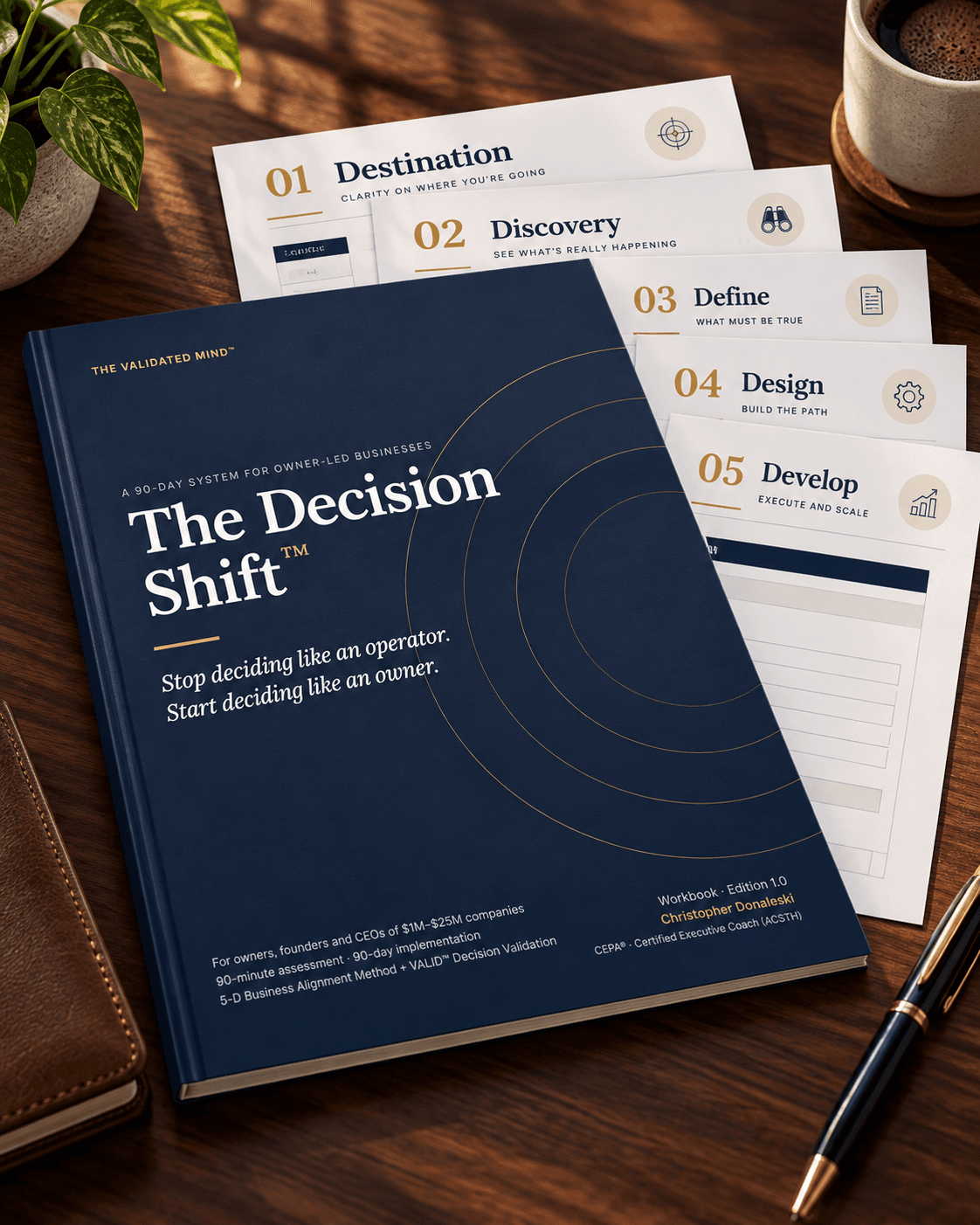
The shift doesn't remove you from your business. It gives you control over direction without control over every call. You do it in five stages over 90 days, and every stage leaves you with a tool you keep using:
- Destination. Define the business you're actually building, and what must be true when you're not in the room.
- Discovery. Trace how decisions really move today, and find the ones quietly landing on you.
- Define. Run the VALID™ review on the decisions that matter and find where intent and reality split.
- Design. Give each decision one owner, clear limits and written guardrails your team can follow.
- Develop. Install a light operating rhythm so the shift holds when you stop paying attention.
You don't have to finish the workbook to start. In 90 minutes you can see the problem. In a week you can find your bottleneck. In 90 days you can make the shift.
Here's exactly what you get.
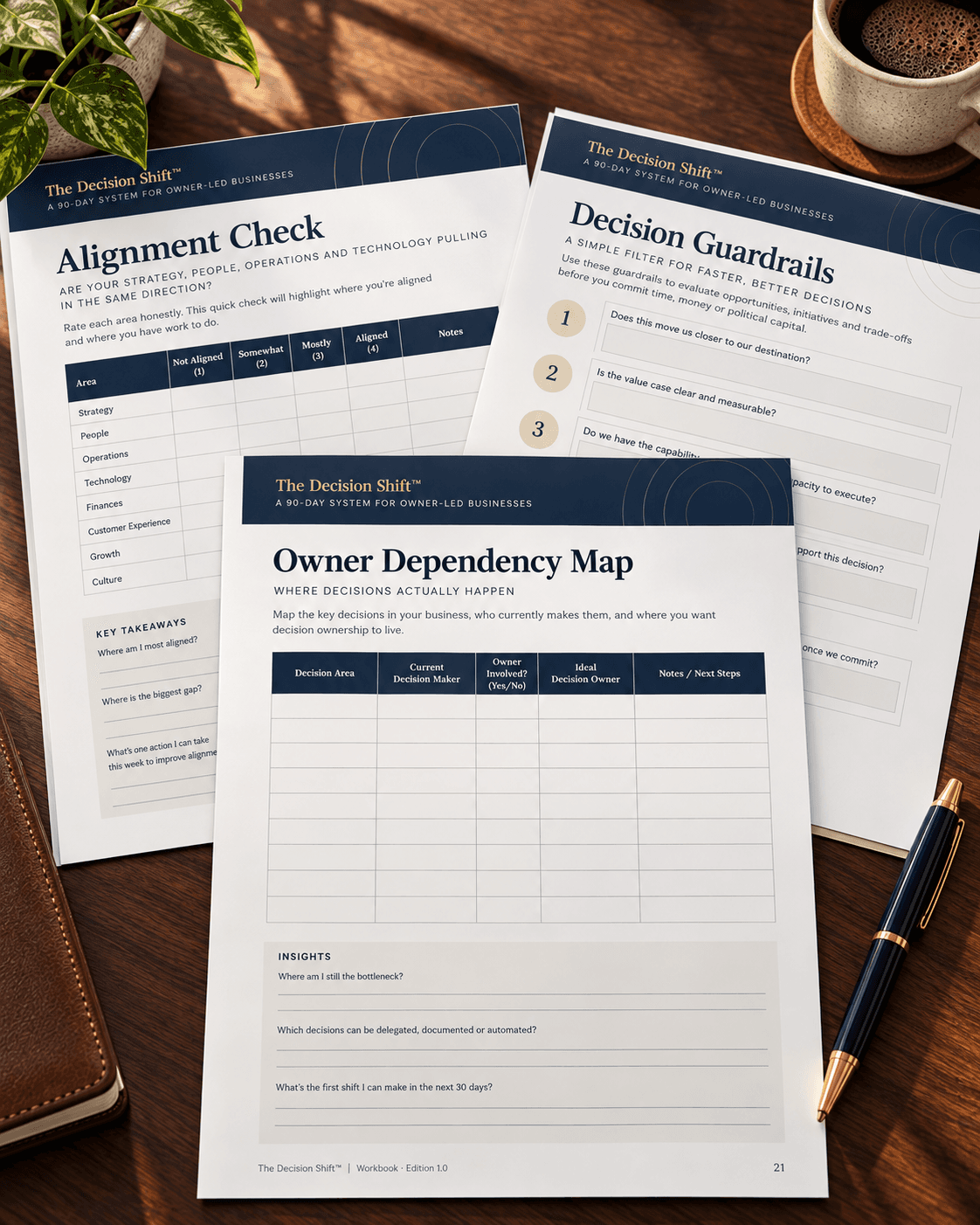
- The 15-minute Alignment Check that scores your business across six dimensions, plus a copy for one manager, because the gap between your answers and theirs is the real finding. (pp. 6–10)
- The one question that exposes every decision you're secretly still holding. Most owners avoid it. Answer it and you have your list. (p. 11)
- The Owner Dependency Map showing exactly which decisions should leave your desk first, plus your owner intervention rate, the number that tells you whether the shift is working. (pp. 18–19)
- The VALID™ Decision Review for the calls that matter, so you fix what's actually producing a problem instead of the symptom in front of you. (pp. 21–22)
- 12 ready-to-fill guardrails for discounts, credits, overtime, purchases, hiring, scheduling, collections, vendors, AI outputs and more. Swap in your numbers. No blank page. (pp. 31–32)
- The exact words to say when you announce the shift, when you hand over a decision, and when someone makes a call you wouldn't have. (p. 36)
- Three meetings that replace interruptions: a 25-minute weekly pulse, a monthly review and a quarterly validation, with agendas and a decision log. (pp. 33–34)
- The 90-day plan that forces you to fix three things, not thirty, with a day-by-day arc. (p. 37)
- The eight ways the shift stalls (“I keep taking decisions back” is one of them) and what to do about each. (p. 39)
- The Dependency Calculator and Day-90 Scorecard so you can put a number on what this is costing you, and see your shift on one page. (pp. 40–43)
- A license for your whole business. Copy the worksheets for every owner, manager and employee.
What owners pay us about $25,000 to do with them. Yours to run for $149.
When an owner hires AI Advisory Group to make this shift, a typical engagement runs about $25,000. We sit down with you and your leadership team, run the Alignment Check across the company, trace where your decisions really go, design the authority and guardrails, coach the hard conversations, and install the operating rhythm. It works. It's also $25,000 and a calendar full of sessions.
The Decision Shift is the same method: the same order, the same tools, the same scripts. What you don't get is us in the room. What you do get is everything you need to run it yourself, for less than 1% of the engagement price.
| Advisory engagement | The Decision Shift™ | |
|---|---|---|
| Who does the work | Christopher and the AIAG team, with you | You and your managers, guided step by step |
| The method | 5-D Business Alignment + VALID™ | The same |
| Timeline | About 90 days, on our calendar | 90 days, on yours. Start tonight. |
| Tools you keep | Yes | Yes, licensed for your whole business |
| Investment | About $25,000 | $149 |
Some owners should hire us, and if the workbook shows you you're one of them, you'll know exactly what to ask for. Most owners should start here.
You don't need more people. You need fewer decisions waiting on you.
When the queue gets long, the instinct is to hire: a general manager, an operations lead, another coordinator. Sometimes that's right. But a new hire walks into the same system everyone else is working inside. If the rules live in your head, they inherit them secondhand, and now there are two people who need to check with you.
And hiring isn't cheap or safe. SHRM's 2025 benchmarking puts the average cost per hire at $5,475 for nonexecutive roles and $35,879 for executives. [6] In a CareerBuilder survey, nearly three in four employers said they had hired the wrong person, at an average cost of $14,900 per bad hire (2017). [7]
Here's the uncomfortable math: every person you add brings more decisions into the business, not fewer. Until someone settles who decides what, headcount just lengthens the line outside your door. The workbook even lists it as one of the places to look for value: a management hire you can delay or avoid.
And the people you already have?
Your team isn't short on talent. They're short on permission. Without written limits, every reasonable call carries the risk of being overruled, so the safe move is to wait for you. That waiting wears everyone down: them, because they can't finish anything, and you, because everything comes back.
Gallup found that an unmanageable workload and a lack of role clarity are among the top five factors linked to burnout, and burned-out employees are 2.6 times as likely to be actively looking for another job (2018). [8] Replacing one can cost one-half to two times their annual salary. [9] The people holding your business together are the ones the queue wears out first.
A guardrail changes that. “You can approve a customer credit up to $500 without asking me” isn't a policy memo. It's relief. It tells a capable person they're trusted, exactly how far, and what to do when it's bigger.
They decide inside clear limits instead of guessing what you'd want.
Work stops piling up in your queue, so it stops piling up on them.
Fewer fire drills. The same problem stops coming back every month.
Your time is the first return. It may not be the biggest.
The calculator values your hours. But once decisions have an owner, a rule and a log, money starts showing up in places most owners never connect to how decisions get made. The workbook points you to twelve of them:
- Overtime and scheduling
- Rework, callbacks and warranty claims
- Discounts and pricing exceptions
- Contract renewals and price increases
- Owner time redirected to sales or key accounts
- Faster quotes and higher win rates
- Customer retention and fewer escalations
- Purchasing and vendor terms
- Hiring mistakes and turnover
- Collections and payment terms
- Errors from AI or software defaults
- A management hire you can delay or avoid
And the AI question everyone keeps asking you.
You're being told to adopt AI. You probably should. But AI is very good at following rules and very bad at inventing them. The workbook sorts every recurring decision into four homes: Owner Reserved, Team Owned, System Enabled and Unowned. The System Enabled ones, routine calls you could predict from a rule or data, are exactly where AI and automation pay off, with a person handling the exceptions.
Do the sort first and you automate the right decisions, inside guardrails. Skip it and you scale a guess. There's even a guardrail in the library written specifically for AI-generated quotes, emails and screening.
What is one week of your time worth?
Run the calculator above honestly and you'll likely find that staying the bottleneck costs you more every week than this workbook costs once. That's not the real cost, though. The real cost is the vacation you won't take, the decision you'll make tired, and the year that goes by with the business still waiting on you.
You can hire someone to help you do this, and if you want that, we do it. But you don't need to. Everything you need to start is in these 47 pages.
Secure checkout by Stripe · instant download · receipt by email
If something's holding you back, it's probably one of these.
“I've already tried a business operating system.”
Good. Keep it. Those systems organize priorities, meetings and accountability, and the workbook works alongside them. What none of them settles is who decides what, with which information, within which limits. That's the gap your meetings keep sending back to you.
“My business is different.”
Your industry is. Your decisions aren't. Every owner-led company makes the same recurring calls: pricing exceptions, credits, purchases, overtime, hiring, scheduling, escalations. The guardrail library starts there. You swap in your numbers.
“My team isn't ready for more authority.”
You don't hand over everything. You decide which calls stay yours (the workbook calls them Owner Reserved), set limits that are specific, and adjust them from a decision log. Trust stops being a leap of faith and becomes a design.
“I'll lose control.”
You'll gain it. Today you control every call you're in the room for and nothing you aren't. After the shift, you control the rules, the limits and the exceptions, and a decision log shows you what was decided without asking you to approve each one.
“I'm about to hire a GM or COO anyway.”
Then do this first. A new leader who walks into written decision rights, guardrails and a rhythm gets traction fast. One who walks into your head spends months learning it secondhand.
“Now isn't a good time.”
It never is, and that's the trap. Your busiest season is exactly when the queue costs the most. The calculator puts a number on every week you wait. Ninety minutes this week is the whole ask.
“It's a lot for a PDF.”
It's not a PDF. It's the method owners pay us about $25,000 to run with them, in 47 working pages, licensed for your whole team. Hand off one decision that costs you an hour a week and it pays for itself in the first month at almost any owner's hourly value.
“What if I start and stall?”
Almost everyone stalls somewhere. The workbook names the eight patterns, from “everything still escalates” to “I keep taking decisions back,” and what to do about each. And if you do the first two exercises and find nothing worth handing off, you get your money back.
“Is this just theory?”
Every page is a working tool with a completed example beside it. You'll write your own decision rules, your own guardrails and your own 90-day plan. You won't be reading about someone else's.
Three steps. The first one takes about a minute.
- Check out securely with Stripe. Card, Apple Pay or Google Pay. You can add your company name for the receipt.
- Download instantly. Your link appears on screen and lands in your inbox. It keeps working for a year.
- Spend 90 minutes this week. Take the Alignment Check, answer the 30-day question and run the calculator. By the end, you'll know the first decision that leaves your desk.
From here, there are two paths.
Tomorrow looks like today. The decisions keep coming. You stay the operating system, and you hope the next hire, the next tool or the next quarter changes it.
See exactly which decisions are holding you hostage, start moving them, and begin building a business that runs the way you intended, with you in it by choice, not by necessity.
A few practical questions.
What exactly do I get?
A 47-page fillable PDF workbook. Type straight into it or print the worksheets. Every worksheet sits beside a completed example so you can see what “done” looks like. Your download link appears on screen the moment you pay, and by email.
My company is smaller (or bigger) than $1M–$25M.
The method is the same; the rhythm scales. The workbook includes specific adjustments for teams under 15 people and over 60.
Can my managers use it?
Yes. Your purchase licenses the workbook for one business: copy the worksheets for that business's owners, managers and employees. Several tools are built to be filled in by a manager separately from you.
Is this a course? Do I need software?
No course, no login, no software. It's a working document you use with your team.
What if it isn't for me?
Use the guarantee: complete the Alignment Check and the Owner Dependency Map. If you don't find a single decision worth taking off your desk, email us your completed pages within 30 days and we'll refund you in full.
I've spent more than 15 years as a business owner, with roots in oil and gas, IT, healthcare and M&A, and I work with owners who have built something real and now find the business can't move faster than they can decide. The Decision Shift is that work, written down so you can run it yourself.
A business should not need its owner to make every decision. But every decision should reflect the business the owner intended to build. Let's build yours.
P.S. Try this tonight, before you decide anything: write down what would break if you disappeared for 30 days. If the list made you wince, that list is where your 90 days start. The workbook walks you through every item on it.
P.P.S. If you do the first two exercises and find nothing worth handing off, you get every dollar back. The only way to lose is to keep waiting.
Sources
- McKinsey & Company, “Decision making in the age of urgency,” McKinsey Global Survey, April 2019. View source
- Blenko, Mankins & Rogers, “Decision Insights: Score your organization,” Bain & Company, 2010 (survey of nearly 800 companies). View source
- Badal & Ott, “Delegating: A Huge Management Challenge for Entrepreneurs,” Gallup Business Journal, April 2015 (study of 143 Inc. 500 CEOs). View source
- Gartner, press release, June 25, 2025: “Gartner predicts over 40% of agentic AI projects will be canceled by end of 2027.” View source
- Value Builder System, Advisor News, “The levers that actually move company value,” February 2026 (data on 80,000+ companies). View source
- SHRM, “SHRM Releases 2025 Benchmarking Reports,” October 15, 2025 (survey of 2,371 SHRM members). View source
- CareerBuilder, “Nearly Three in Four Employers Affected by a Bad Hire,” December 7, 2017 (Harris Poll survey of 2,257 hiring managers and HR professionals). View source
- Wigert & Agrawal, “Employee Burnout, Part 1: The 5 Main Causes,” Gallup, July 12, 2018. View source
- McFeely & Wigert, “This Fixable Problem Costs U.S. Businesses $1 Trillion,” Gallup, March 13, 2019. View source
- AI Advisory Group case study, “How Gladegy Cut Project Overhead by 60% Without Adding Complexity.” View source
© 2026 OSQ International, Inc. The Decision Shift™, The Validated Mind™ and VALID™ are trademarks of OSQ International, Inc. Client results reflect advisory engagements and are not a guarantee of individual outcomes. The workbook is general business guidance and does not constitute legal, tax, accounting, HR or compensation advice. Privacy · Terms